Dan Everett Did He Ever Visit Piraha Again
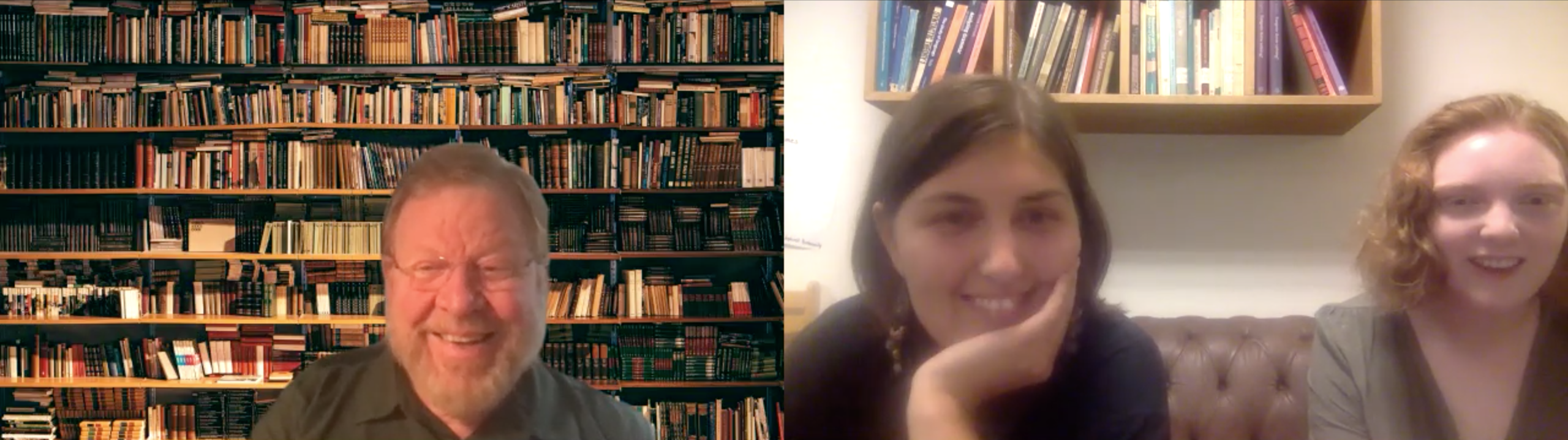
One evening, Linea Flansmose Mikkelsen and Liv Moeslund Ahlgren met upwards in Lingoland at Aarhus Academy and set up a zoom-connection beyond the Atlantic Ocean to talk to Dan Everett. He is an American linguist, best known for his piece of work on the Pirahã language, and is currently a professor at Bentley University. This is the beginning function of the interview, where we talk about Dan Everett's career, motivations and his dream project.
In the second function of the interview, we discuss the ethical aspects of doing fieldwork.
Can y'all tell a bit about yourself and how yous got into linguistics?
Yeah, so I got into linguistics in club to be a bible translator. I met a immature woman in high school who was raised in Brazil, a child of missionaries. Information technology was during the sixties, yous know, then it was similar "this is a great culling to Western capitalist culture, I'll go live in the Amazon and be a missionary!". But to be a missionary I had to acquire about bible translation, and to larn about bible translation I first had to take linguistics.
I really fell in love with it and I went off to the University of Campinas in São Paulo to exercise a PhD, and I wrote my doctoral dissertation on the Pirahã and dedicated in 1983. After a few years I moved away and forth the way I became an atheist and no longer a missionary. I had been much around, and now this is my 11th year at Bentley. I was the dean there for 8 years, the Vice President of Academics for ane year, and now I am back to what I like best which is being a professor. Linguistics and the understanding of human being language and cognition – these accept become the nigh interesting things in the globe to me. Information technology's what I call up about from the time I go upwardly to the time I become to bed.
Why were y'all sent specifically to the Pirahã village in the offset place?
When we were assigned to become bible translators, we could have called whatever country. I thought almost New Guinea. But then I got a alphabetic character from Steven Sheldon, and he said "I have worked with the Pirahã for nine years, and before that Arnold Heinrich worked on it for some other nine years, and neither one of us have been able to effigy out the language – it'south just, in that location is something really different about this language. We were wondering if you would be willing to take on the Pirahã?". And y'all know, I was 25 years old so everything sounded easy, so I said "Certain, I'll practice that!". Turns out, trying to figure out Pirahã was the hardest matter I've ever done in my life, I'll never exercise anything that hard again: It'southward a language isolate, they are semi-nomads, they live in the jungle, at that place is lots of malaria, at that place are no modern conveniences, I couldn't afford a tape recorder. It was only me and my pen and paper.
At some point, while figuring out this language and describing it, it must have occurred to y'all that information technology wouldn't fit the linguistic theory you had been taught. Can you say something nearly that?
Well, when I was doing my initial research I found all kinds of things, merely I believed that just because I didn't know how to handle it, it didn't mean that it was a serious problem. A amend linguist than me would come along and bear witness me how to handle it. Afterwards, I went to MIT, and my office was next to Chomsky'due south for a yr, and he and I talked a lot. He wrote me letters of recommendation, and told everybody how well I understood his ideas. Of course, now he says that I don't understand them at all, but back then he idea that I understood them.
Later on my time at MIT, I went back to the village and thought "These things really don't fit, and the reason they don't fit is because yous tin can't isolate course from meaning, you have to look at all of it in context". And in one case you beginning doing that, you see at that place are some aspects of linguistic form that surprisingly enough are related to other aspects of the civilization. Information technology all fits together: the culture, the language. You can't dissever them, you tin't dissever form from significant – which has always been Chomsky's approach. In 2004, I went to the Max Plank Plant for Evolutionary Anthropology and started working on how to link together culture and grammar, and to see if that fabricated whatsoever sense. And y'all know, that work pb to a lot of controversy. But at the same time information technology established a new path for me, something that I've been going down for now over 15 years.
It wasn't until I was a well-established scholar that I realized, I don't have to fit anybody's mold. I've got a great job, and I can just look at Pirahã from a genuinely honest perspective. I could throw out all of this theoretical commitment and reapproach it from the perspective of trying to fit everything together and trying to actually understand information technology. And I've always found that that'southward where the most interesting insights are. They don't come from post-obit the theory and seeing, you lot know. The earlier stuff I did that was very theoretical. It got me jobs and invitations to conferences, but information technology'south really not the almost pregnant stuff I've washed.
So would you lot say that your fields of interest take inverse much during your career?
Yeah, changed dramatically. I went from studying linguistics just so it would help me empathise Pirahã to really wanting to understand the nature of homo language – to look at its philosophical aspects, its linguistic aspects, its cultural aspects, its psychological aspects.
What are you working on now?
These days I'grand working on semiotics, the theories of Charles Sanders Peirce. I have some manufactures in the works, only my ii volume projects right now are the biography of Charles Sanders Peirce for Princeton University Press, and I'm also writing a volume for Oxford Academy Press chosen Peircean Linguistics. How would linguistics be washed inside a Peircean framework? Those two projects volition take me a couple of years.
Practise you lot besides think that the linguistic academic landscape has inverse? Is there more focus on language and civilisation than the cognitive aspects of language?
Well, clearly there is a whole group that still do Chomskyan linguistics, and they look at grade apart from meaning. Only at the same time there are other groups started. You know, in that location are a number of people around the globe who are doing really exciting work, looking at the intersection of language, meaning and all kinds of interdisciplinary areas. So I'one thousand excited almost that, I think that's extremely healthy for the field.
If you lot had unlimited time and funding, what projection would you do? What would you want to acquire?
I would desire to exercise a series of volumes on a language that would include an encyclopedia, a dictionary, lots of texts, a grammar – every bespeak in the grammar tested psychologically and experimentally, to see if it really worked. I would take a large team working over a period of years to come up up with a cognitive science perspective of this people as a whole – of which their linguistic communication is simply a part. That would take a long time and a lot of money.
Exercise y'all think that kind of description could be done? Could it even be done for the cultures and languages that nosotros already know?
Information technology could be washed, but you lot accept to realize that nobody has the terminal word on stuff. Every grammar that's been written should exist rewritten – not considering information technology's totally wrong, simply but considering everybody has a different perspective. So yeah, a project with a large squad, hopefully a multinational squad of psychologists, phoneticians, syntacticians, anthropologists and fifty-fifty philosophers working together for, say, a decade could produce a marvelous output! That wouldn't mean that it'south the truth, but it would be pretty shut. So another team would do another one and it would be different and contradict the first, and that's just the way things piece of work.
Charles Sanders Peirce said that the truth is what awaits us at the end of all research, when all people trying to solve a trouble have finally reached a consensus that it is solved – and when will nosotros get in that location? In nobody's lifetime.
And that'southward also the funny role, right, you always have work to do!
Yeah, I'm excited! I tell my dr., you know, "I don't accept time to die, I've got all this stuff I've gotta get figured out", and he says "That's what everybody says!". Only you know, it does keep me motivated, it does go on me going, it keeps me excited. Every day when I get up, I don't accept to worry what am I gonna do with myself today. And it's ane reason I'll never retire, you know. It'south a wonderful profession.
And so are you happy that you concluded upward condign a linguist?
Working in academics is dandy, because there is but something very heady and noble about finding things out. I was a musician, I wanted to exist a rock star during about of my early on life, and I realize that what I'm doing now is just as artistic, it's simply as satisfying as writing songs – more than then in some means. I have no regrets. I'one thousand very happy with my life. There'south no profession I tin can imagine that is better, more than exciting, more fulfilling than being a university professor. Information technology'southward just, it's wonderful. After 40 years of doing this, I still tin can't believe my luck.
Liv Moeslund Ahlgren is an MA student of linguistics at Aarhus University. She has worked with gender studies and postcolonialism every bit a part of her linguistics small-scale.
mclaughlinandareat.blogspot.com
Source: https://www.lingoblog.dk/en/dan-everett-on-the-excitement-of-being-a-linguist/
0 Response to "Dan Everett Did He Ever Visit Piraha Again"
Post a Comment